On this page
3
Elaboration of the Master Plan
Med-TSO members follow a common process for coordinated planning. This involves preparing and assessing a development plan for interconnection projects between their transmission systems to support the energy transition in the Mediterranean area.
To ensure the energy transition is cost-effective and secure, the portfolio of interconnection projects is assessed against various possible energy futures. These futures reflect different trends in load and generation, based on carefully developed long-term scenarios.
These scenarios outline the path from the current situation to the target time horizon and provide a robust framework for grid development studies. Based on this, the interconnection projects in the MMP are assessed using a techno-economic approach, which relies on results from market and network studies.
To support this goal, the Methodology for the Long-term Network Development Plan includes the following key steps:
- Defining Mediterranean energy scenarios.
- Identifying a list of future interconnection projects.
- Creating regional-level reference models of the power system for market studies.
- Analysing network behaviour through load flow calculations and identifying necessary investments to meet security standards.
- Conducting a Cost-Benefit Analysis (CBA) for the proposed investments.
This edition of the Master Plan of Interconnections is an update of the report published by Med-TSO in 2022. As such, it does not follow the full methodology described above, but focuses only on updating one of the Mediterranean scenarios and the results of the related CBA. Given the maturity level of the assessed projects, the network studies presented in the 2022 report have not been revised.
3.1
Projected evolution of Mediterranean Power Systems by 2030
The scenario-building process developed by Med-TSO serves as the foundation for assessing future energy needs. It offers a quantitative basis for infrastructure assessment and network planning by defining a set of plausible futures against which system performance can be tested. In practice, these scenarios are designed to capture the dynamic uncertainties of the energy transition.
The Med-TSO framework includes three long-term scenarios: Inertial, Proactive and Mediterranean Ambition, which represent different levels of interaction among national power systems, ultimately aiming at a more coordinated Mediterranean Power System. These 2040 scenarios outline possible pathways from the present to a range of future trends in energy demand, electricity generation, sector coupling, technological development, policy directions, and decarbonisation goals. They provide a solid foundation for grid development studies.
However, the level of uncertainty for the 2030 horizon is relatively low. As a result, Med-TSO has developed a single projection for the medium-term evolution of Mediterranean electrical systems. This projection is aligned with the NT+2030 scenario from the TYNDP2024 for European countries.
By 2030, electricity consumption across all Mediterranean countries (excluding electricity demand dedicated to renewable hydrogen production), is expected to reach approximately 2,470 TWh, marking a 20% increase from the reference year 2023. To meet this rising demand, particularly in the context of the energy transition, the development of renewable energy is set to accelerate, continuing the strong growth seen over the past two to three years, especially in solar and wind power. As a result, the share of electricity consumption covered by Renewable Energy Sources (RES) is projected to exceed 50% by 2030, up from 32% in 2023. Simultaneously, most of the highest CO₂ emitting thermal power plants are expected to be permanently decommissioned or have their output significantly reduced. This shift is anticipated to result in a 36% decrease in CO₂ emissions from electricity generation compared to 2023 levels across the Mediterranean region.
These elements are presented in detail in another key deliverable of the TEASIMED 2 project: the Med-TSO Scenario Report for the 2030 and 2040 horizons. The report outlines how the evolution of power systems will influence the electricity exchanges between Mediterranean countries in 2030.
The interconnection network linking Mediterranean countries enables electricity exchanges based on the complementarities between connected systems. These complementarities take various forms, for example, economics, where electricity flows from countries with lower production costs to those where generation is more expensive. They may also arise from supply-demand imbalances, allowing a country facing a temporary deficit to rely on available capacity from its interconnected neighbours. In addition, complementarity can result from the large-scale development of non-dispatchable renewable energy, where surplus generation at certain times of the day can be exported through interconnections.
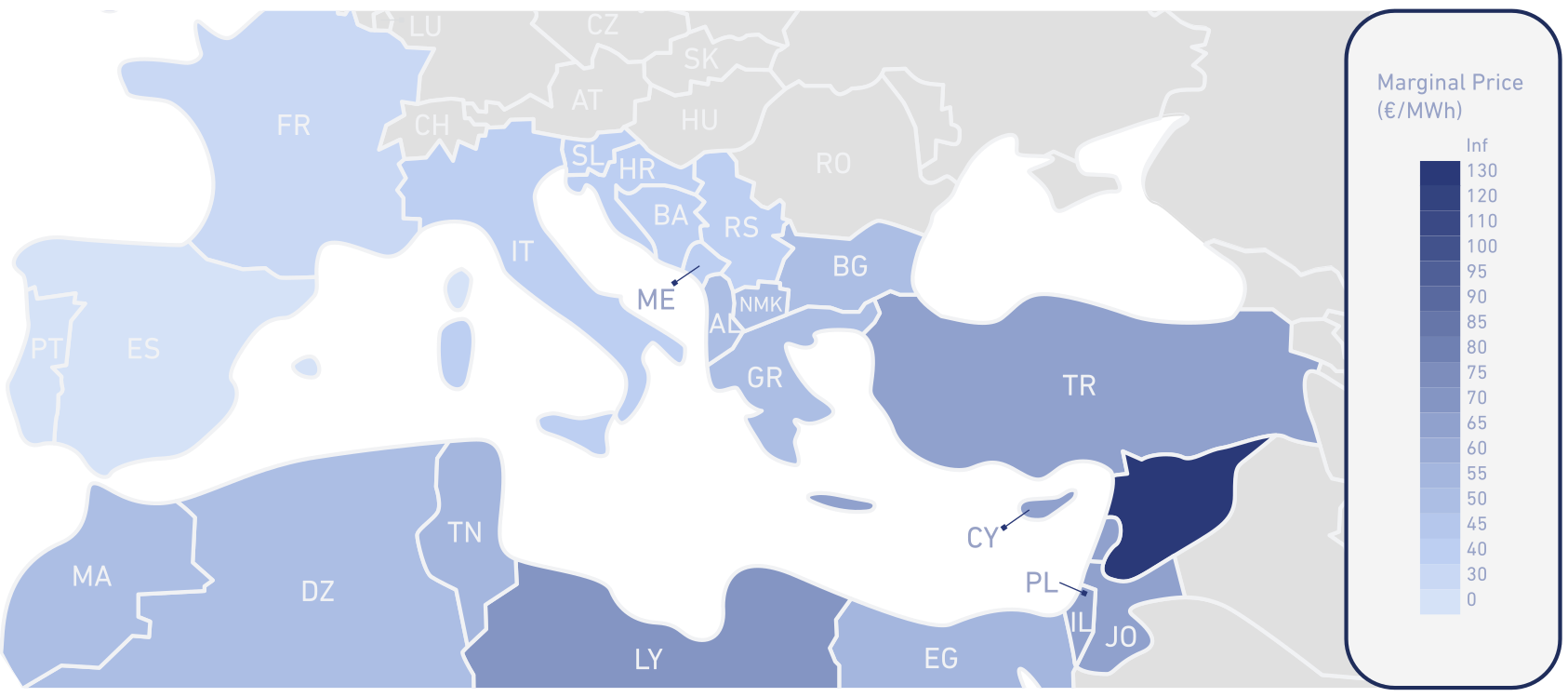
On the map above, each country or bidding zone is coloured according to its annual average marginal electricity production cost, expressed in €/kWh. Spain, Portugal and France show the lowest average marginal prices among Mediterranean countries, thanks to their abundant decarbonised generation mix, including nuclear, hydroelectric, wind and solar power. This cost advantage results in predominantly export-oriented electricity flows towards northern Italy on one side, and the western Maghreb — particularly Morocco and Algeria — on the other.
In the central part of the region, projections for 2030 indicate a relatively higher average Elaboration of the Master Plan 15 marginal price in Libya compared to its neighbouring countries. At the same time, the growth of renewable energy in southern Italy positions this area as a net exporter. Although electricity flows are generally oriented from north to south, such as from Italy to Tunisia, and from Algeria to Libya —reverse flows also occur. This highlights the bidirectional use of interconnections and the effective exploitation of complementarities between countries.
In the Southeastern Mediterranean, Egypt is projected to maintain a net export balance with all neighbouring countries by 2030. This is driven by the development of decarbonised energy sources (wind, solar, and nuclear) and a modern, highly efficient gas-fired power plant fleet. The interconnection with Saudi Arabia remains generally balanced over the year, reflecting strong complementarities between the two power systems, especially due to their offset in peak consumption periods.
In the northeast, Türkiye is projected to have a relatively high average marginal price by 2030. This is due to the expected continued growth in electricity demand and an aging thermal power plant fleet, despite significant progress in renewable energy development. As a result, electricity exchanges in the southern Balkans are expected to move predominantly from west (Greece and Bulgaria) to east (Türkiye) by 2030. A similar trend is anticipated further south, with projected flows from Greece to Cyprus and Israel, driven by regional economic optimisation of thermal generation and reduced curtailment of renewable energy in Cyprus.
In the Middle East, Syria is expected to continue facing a severe electricity deficit through 2030, necessitating maximum electricity imports from neighbouring countries, depending on the availability of electrical networks. In Lebanon, electricity exchanges, particularly with Jordan, could reach a more balanced state if the country secures access to natural gas to operate its CCGT (combined-cycle gas turbines) power plants. By 2030, Jordan emerges as a key player in regional electricity exchanges, serving as a hub for connections with Syria and Lebanon to the north; Iraq, Saudi Arabia, and Egypt to the east and south; and Palestine via its link with the West Bank.
3.2
Proposed investment clusters and their rationale
The Mediterranean electricity network spans a vast and diverse region, characterised by significant variability in generation mixes, weather conditions, renewable generation potential, and demand patterns.
To address the diverse system needs across regions, TSOs propose investment clusters and interconnection projects tailored to specific challenges. To facilitate the identification of these clusters, the system needs they address have been categorised into defined project benefit types, as shown in the following table.
Some project benefits can be directly quantified using the benefits typically considered in Elaboration of the Master Plan 16 a Cost-Benefit Analysis. This is particularly true for benefits under the first macro-category, ‘Welfare, Sustainability and Security of Supply’, which includes factors such as economic welfare generated by the project, reduced curtailment of renewable energy sources (RES) and associated CO₂ emissions and lower levels of Energy Not Supplied (ENS). Other benefits, however, are assessed qualitatively and are represented using symbols and specific descriptions linked to each project.
| Category | Detailed Project Merits | Associated System Needs | Symbol |
|---|---|---|---|
| Welfare, Sustainability and Security of Supply (SoS) | Reduce high price differentials between different market nodes/ countries Positively contribute to the reduction of RES curtailment and CO2 emission levels Contribute to solving adequacy and security of supply issues | By increasing the net transfer capacity between market zones, cross-border interconnections enable additional electricity flows from countries with lower production costs to those with higher production costs. This reduces price differentials between zones, thus creating value for the consumer and the whole system. As a result of the additional enabled flow, interconnections also contribute directly to reducing RES curtailment. Surplus renewable (and typically low-cost) electricity produced in a given zone can be exported to another, thereby reducing the overall emission factor of the generation mix. Furthermore, imported electricity from other countries serves as an additional resource during scarcity periods, ensuring the balance between supply and demand, and enhancing security of supply. | |

| Isolation | Fully or partially address the isolation of countries from the interconnected power system or contribute to achieving specific interconnection targets. | This benefit is particularly relevant for isolated systems (e.g. islands) and for those with a low level of connectivity. It may also apply to projects that support countries in achieving interconnection targets, such as those set by the Clean Energy Package of the European Commission. | |

| Operation-Flexibility | Introduce additional system restoration mechanisms. Improve system flexibility and stability. Increase system voltage stability. Contribute to the integration of new RES generation capacity. | In the coming years flexibility needs are expected to evolve in both nature and volume, due to the increased penetration of weather-dependent generation (replacing conventional fossil fuel power) and power electronic-based devices. In this context, cross-border interconnections can play a key role in reducing and covering flexibility needs. Cross-border interconnections enable not only the exchange of energy, but also the provision of flexibility services between countries in the same interconnected power system. This helps reduce overall flexibility needs. In some cases, interconnections themselves can provide some flexibility services (e.g. through HVDC converter stations), thus contributing to system restoration and overall resilience. The flexibility enabled and provided by interconnections ultimately supports the integration of a greater share of RES into the power system. | |

| Operation- Flows | Enable cross-border flows to overcome internal grid congestions. Mitigate loop flows in bordering systems. | By enabling new exchanges or increasing existing transfer capacity between market zones, cross-border interconnections can be particularly effective for countries experiencing internal grid congestions or physical loop flows involving other market zones. |

Table 1 – Project benefits categories and description.
Category
Detailed Project Merits
Associated System Needs
Symbol
Welfare, Sustainability and Security of Supply (SoS)
Reduce high price differentials between different market nodes/ countries
Positively contribute to the reduction of RES curtailment and CO2 emission levels
Contribute to solving adequacy and security of supply issues
By increasing the net transfer capacity between market zones, cross-border interconnections enable additional electricity flows from countries with lower production costs to those with higher production costs. This reduces price differentials between zones, thus creating value for the consumer and the whole system. As a result of the additional enabled flow, interconnections also contribute directly to reducing RES curtailment. Surplus renewable (and typically low-cost) electricity produced in a given zone can be exported to another, thereby reducing the overall emission factor of the generation mix. Furthermore, imported electricity from other countries serves as an additional resource during scarcity periods, ensuring the balance between supply and demand, and enhancing security of supply.
Isolation
Fully or partially address the isolation of countries from the interconnected power system or contribute to achieving specific interconnection targets.
This benefit is particularly relevant for isolated systems (e.g. islands) and for those with a low level of connectivity. It may also apply to projects that support countries in achieving interconnection targets, such as those set by the Clean Energy Package of the European Commission.
Operation-Flexibility
Introduce additional system restoration mechanisms.
Improve system flexibility and stability.
Increase system voltage stability.
Contribute to the integration of new RES generation capacity.
In the coming years flexibility needs are expected to evolve in both nature and volume, due to the increased penetration of weather-dependent generation (replacing conventional fossil fuel power) and power electronic-based devices. In this context, cross-border interconnections can play a key role in reducing and covering flexibility needs. Cross-border interconnections enable not only the exchange of energy, but also the provision of flexibility services between countries in the same interconnected power system. This helps reduce overall flexibility needs. In some cases, interconnections themselves can provide some flexibility services (e.g. through HVDC converter stations), thus contributing to system restoration and overall resilience. The flexibility enabled and provided by interconnections ultimately supports the integration of a greater share of RES into the power system.
Operation- Flows
Enable cross-border flows to overcome internal grid congestions.
Mitigate loop flows in bordering systems.
By enabling new exchanges or increasing existing transfer capacity between market zones, cross-border interconnections can be particularly effective for countries experiencing internal grid congestions or physical loop flows involving other market zones.
Table 1 – Project benefits categories and description.
The listed benefits have served ad a basis for TSOs to propose cross-border interconnection projects for assessment within the framework of the TEASIMED 2 project.
3.3
Market studies approach and CBA methodology
Scenario building provides Med-TSO members with a common framework to quantitatively assess, on a pan-Mediterranean level, national assumptions regarding the evolution of load and generation fleets for Med-TSO 2030 scenario. Given the weather-dependent nature of renewable energy sources and the varying operating conditions of load and generation, market studies are conducted using a probabilistic approach. These studies focus on the impact of weather conditions, such as wind, temperature and insulation, using available weather databases.
Market simulations involve the economic optimisation of the total generation cost across the entire Euro-Mediterranean Power System, including commercial exchanges between bidding zones. The physical network is taken into account primarily to determine interconnection exchange capacities and, where relevant, minor internal constraints.
The market simulator used is ANTARES, a sequential Monte-Carlo-based, multi-area simulator developed by RTE, the French TSO, designed to assess generation adequacy and economic efficiency across interconnected power systems.
The implementation of market models provides a comprehensive and detailed view of the Mediterranean Power System’s behaviour, using a wide range of indicators and physical quantities at hourly resolution. The output data includes, but is not limited to, power and energy generation by plant type and by country, cross-border exchanges, marginal production prices, national energy balances, expected unsupplied energy, renewable energy curtailment and CO₂ emissions.
The Cost Benefit Analysis (CBA) methodology is designed to evaluate the benefits and costs of new interconnection projects, offering consistent data and indicators to support their assessment. The primary objective of the CBA methodology used in this Master Plan is to establish a common and uniform framework for evaluating these projects.
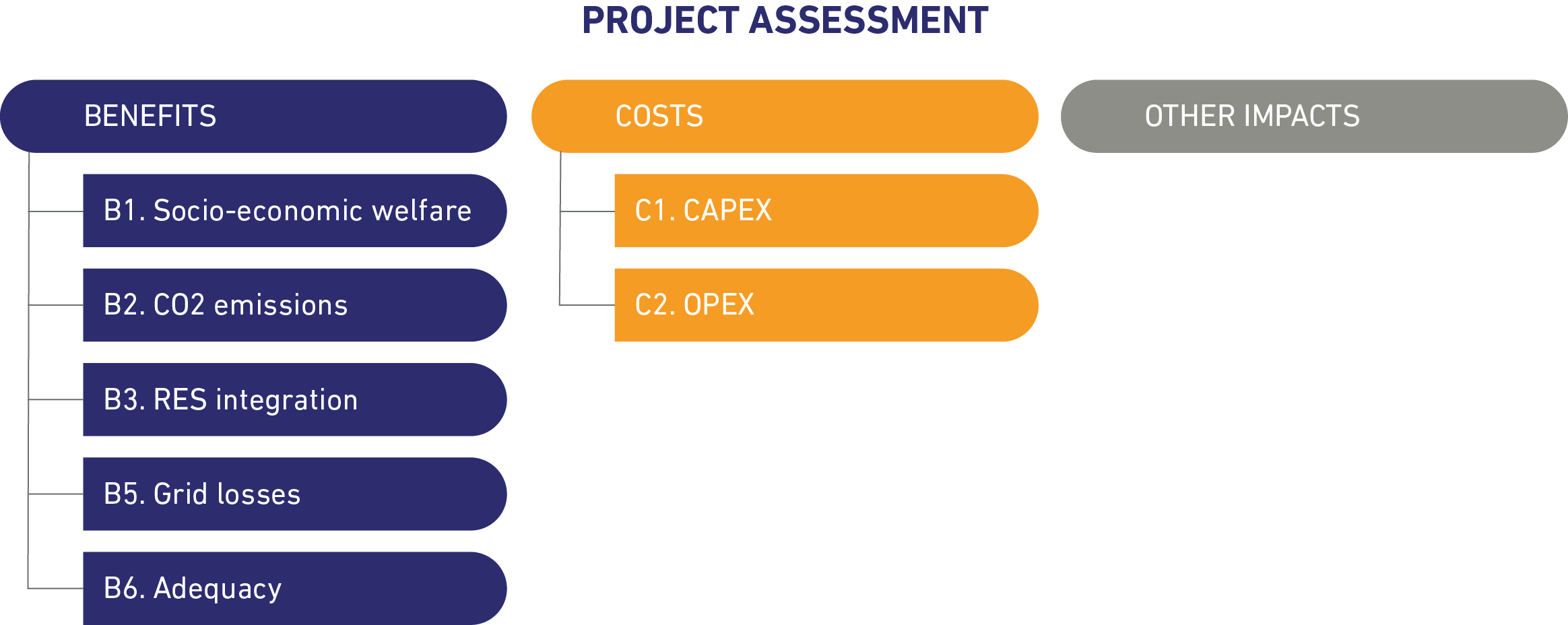
The following set of common indicators provides a comprehensive and robust foundation for project assessment across the Mediterranean region within the scope of the Mediterranean Project. The multi-criteria approach highlights the key aspects, advantages and limitations of each project, offering sufficient information to support informed decision-making. The indicators are summarised in the figure below and described in subsequent sections.
B1. Socio-economic welfare (SEW) or market integration reflects a project’s ability to reduce congestion between bidding zones, thereby increasing transmission capacity and facilitating more efficient electricity trading across markets. SEW quantifies the annual cost savings achieved by the system due to the project, including fuel cost savings, monetised savings in the CO₂ emissions, and variations in the Expected Energy Not Supplied (EENS). It is important to note, however, that SEW does not account for changes in grid losses, which are evaluated separately through a different indicator.
B2. Variation in CO2 emissions captures the change in CO₂ emissions in the power system resulting from the implementation of a new project. It is a consequence of the effects measured in B1 (Socio-economic welfare) and B3 (RES integration) as the project may enable the use of lower-carbon generation sources. Although the economic impact of CO₂ emission changes is already included in the SEW calculation, the CO₂ variation is presented as a standalone indicator due to its strategic importance for the Mediterranean region’s decarbonisation goals.
B3. RES integration: Support for RES integration refers to the system’s ability to connect new RES plants and enable both existing and future “green” generation, while minimising curtailments. Although this indicator is economically included in the calculation of SEW (since changes in RES integration affect energy from conventional sources and, in turn, system costs), RES integration remains a key objective in the Mediterranean region and is therefore presented separately.
B5. Variation in losses in the transmission grid is an indicator that reflects the change in energy losses in the transmission grid resulting from the new project, serving as a measure of energy efficiency. The monetisation of these losses is based on the hourly marginal electricity price, as determined in the market studies and further explained in the relevant section of the Network Studies chapter.
B6. Security of supply: The indicator of adequacy to meet demand assesses the project’s Elaboration of the Master Plan 20 impact on the power system’s ability to supply sufficient electricity to meet demand over an extended period. It accounts for the variability of weather conditions that influence both electricity demand and renewable energy generation. Monetisation of B6 is based on the Value of Lost Load (VOLL) set at €3,000 MWh. In the SEW assessment, peak generation capacity is adjusted to ensure that the adequacy criterion — Loss of Load Expectation (LOLE) — remains below three hours per year in every Mediterranean country.
Sector coupling
The modelling link between electricity and hydrogen systems via electrolysers establishes sector coupling. Electrolysers use surplus electricity from RES and/or nuclear sources to produce low-carbon hydrogen. As a result, the development of new interconnections can influence how electrolysers operate. In a simplified two-country scenario, increasing electricity export capacity reduces RES curtailment in the exporting country and delivers carbon-free electricity to the importing country. Depending on where the electrolysers are located, new interconnections may decrease or increase low-carbon hydrogen production.
The calculation of the B1 indicator must account for these mechanisms to capture the full value of SEW. The detailed modelling and calculation method is described in Chapter 2.6.2 of the ENTSO-E document called Implementation Guidelines for TYNDP 2022, based on the third ENTSO-E Guidelines for Cost benefit Analysis of Grid Development projects.
CBA reporting
The calculation of B1, B2, B3 and B6 indicators is performed over 35 climatic years. For each project, the Mediterranean Master Plan presents the average, minimum and maximum values. The geographical scope for these indicators extends beyond Mediterranean countries to include the entire interconnected Euro-Mediterranean electricity system.
Indicator B5, which relates to grid losses, is calculated using data from the 1990 climatic year only, as it most closely reflects the annual exchanges on Mediterranean interconnections across the 35-year dataset.