On this page

4

The Master Plan of Interconnections

4.1

Presentation of the transmission projects

Interconnection projects have been proposed for updated assessment due to multiple drivers. Interconnectors offer various benefits, including improved market efficiency, lower costs for end users, greater integration of renewable energy, enhanced security of supply and increased power system stability.

In this edition of the Master Plan, Med-TSO members have proposed a total of ten interconnection projects for assessment.

corridors-and-regions-to-cluster-assessed-projects-projects-2030-v2
Figure 2: Marginal electricity price in the Mediterranean in 2030
CategorySymbolDetailed Project Benefits Legend
1. Welfare, Sustainability and SoS1.1) Reduce significant price differences between market nodes/countries.
1.2) Help lower RES curtailment and reduce CO₂ emissions.
1.3) Support the resolution of adequacy and security of supply challenges.
2. Isolation2.1) Fully or partially address the isolation of countries in the power system or help meet specific interconnection targets.
3. Operation Flexibility3.1) Introduce additional system restoration mechanism.
3.2) Improve system flexibility and stability.
3.3) Increase system voltage stability.
3.4) Help integrate the new RES generation capacity.
4. Operation Flows
4.1) Enable cross-border flows to overcome internal grid congestion.
4.2) Mitigate loop flows in bordering systems.

Table 3: Legend of project benefits

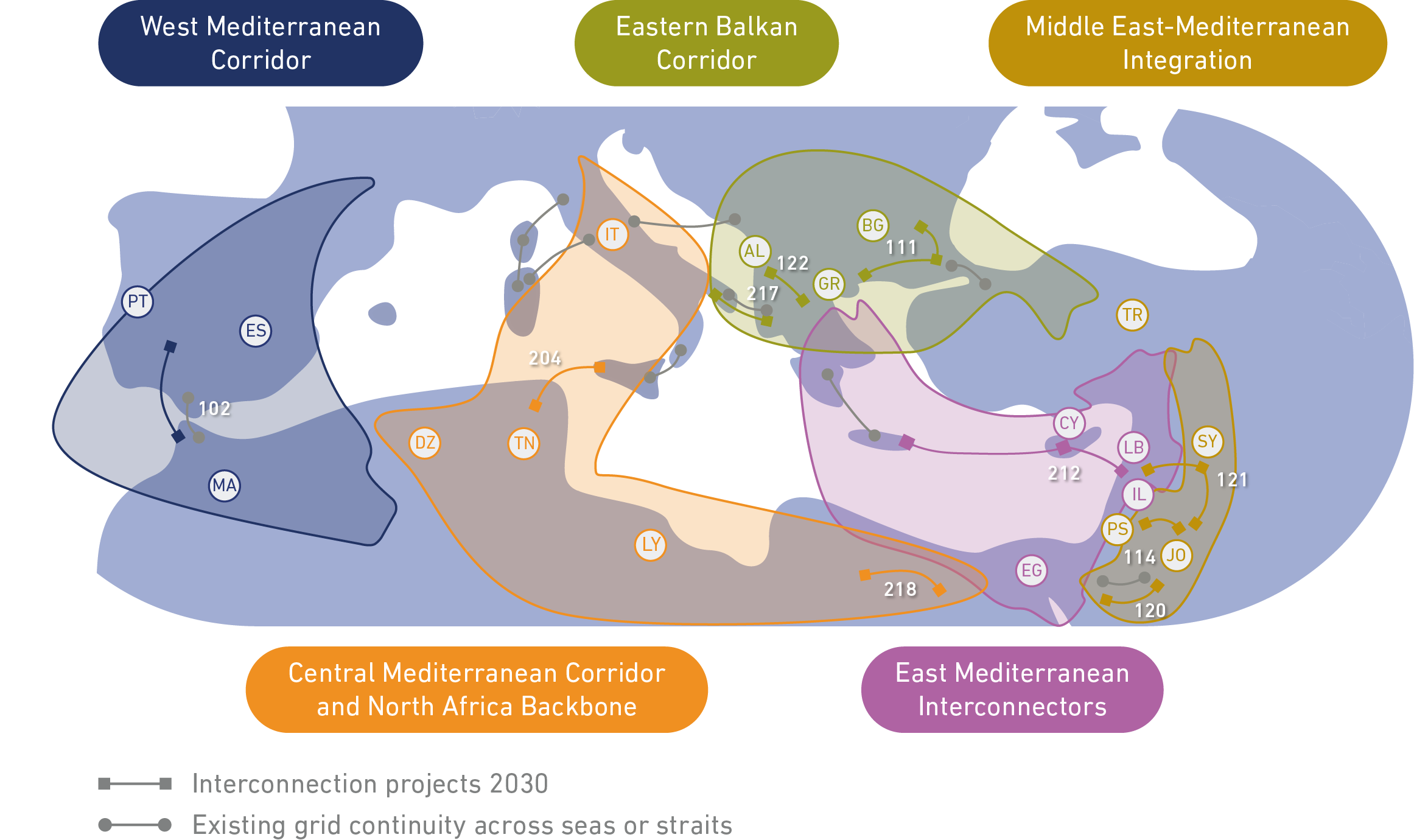
Projects have been grouped into five corridors or regions (project clusters) to better reflect shared drivers and needs, as well as common geographical and network characteristics.

Projects Corridor/RegionProjects comprising the Corridor/RegionNominal transfer capacity (MW)Potential expected benefit form the clusterDetailed benefits
West Mediterranean CorridorProject 102: Spain - Morocco±600/6501.1, 1.2, 2.1, 3.1, 3.4
Central Mediterranean Corridor & North Africa BackboneProject 204: Italy - Tunisia+6001.1, 1.2, 1.3, 3.2, 3.3, 3.4, 4.1
Project 218: Egypt - Libya+7601.1, 1.3, 2.1, 3.3, 3.4
East Mediterranean InterconnectorsProject 212: Greece - Cyprus - Israel+1000/+10001.1, 1.2, 1.3, 2.1, 3.1, 3.2, 3.3, 3.4, 4.1
Eastern Balkan CorridorProject 111: Bulgaria - Türkiye - Greece
+ 1100/- 700
± 600
1.1, 1.2, 2.1, 3.4
Project 217: Italy - Greece+10001.1, 1.2, 3.2, 3.3, 3.4. 4.1
Project 122: Albania - Greece+2001.1, 1.2, 1.3, 3.1, 3.2, 3.3, 3.4
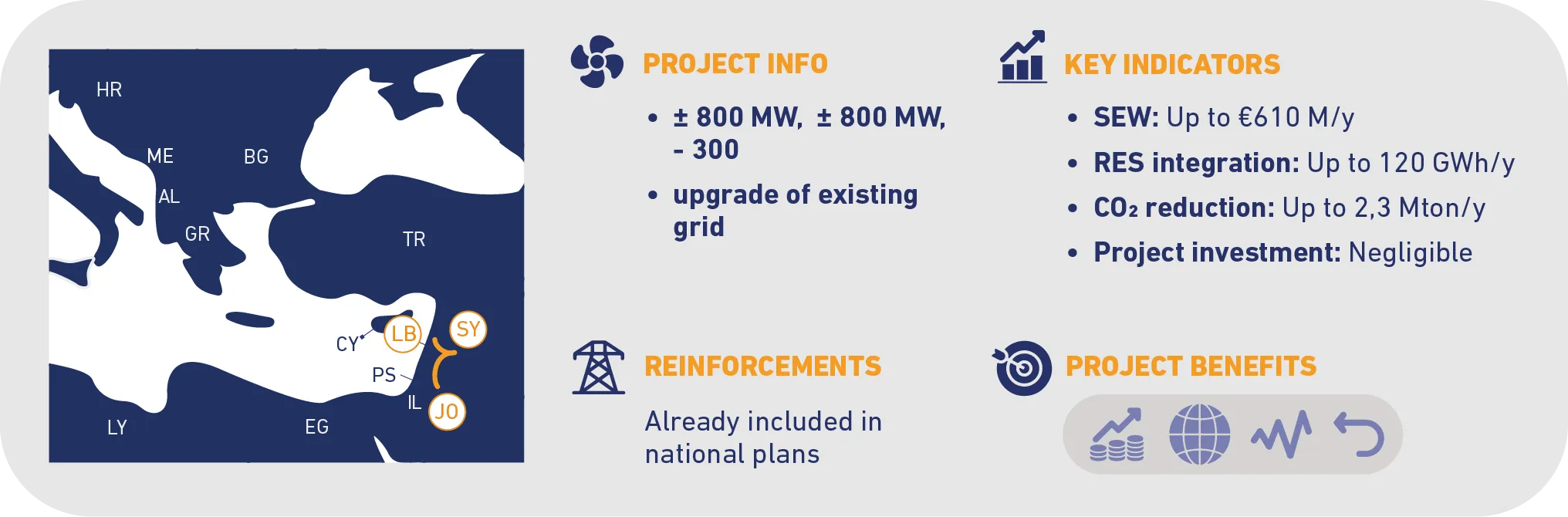
Middle East Mediterranean IntegrationProject 121: Jordan - Syria - Lebanon+800/+800/-3001.1, 1.2, 1.3, 2.1, 3.2, 3.3, 3.4, 4.1
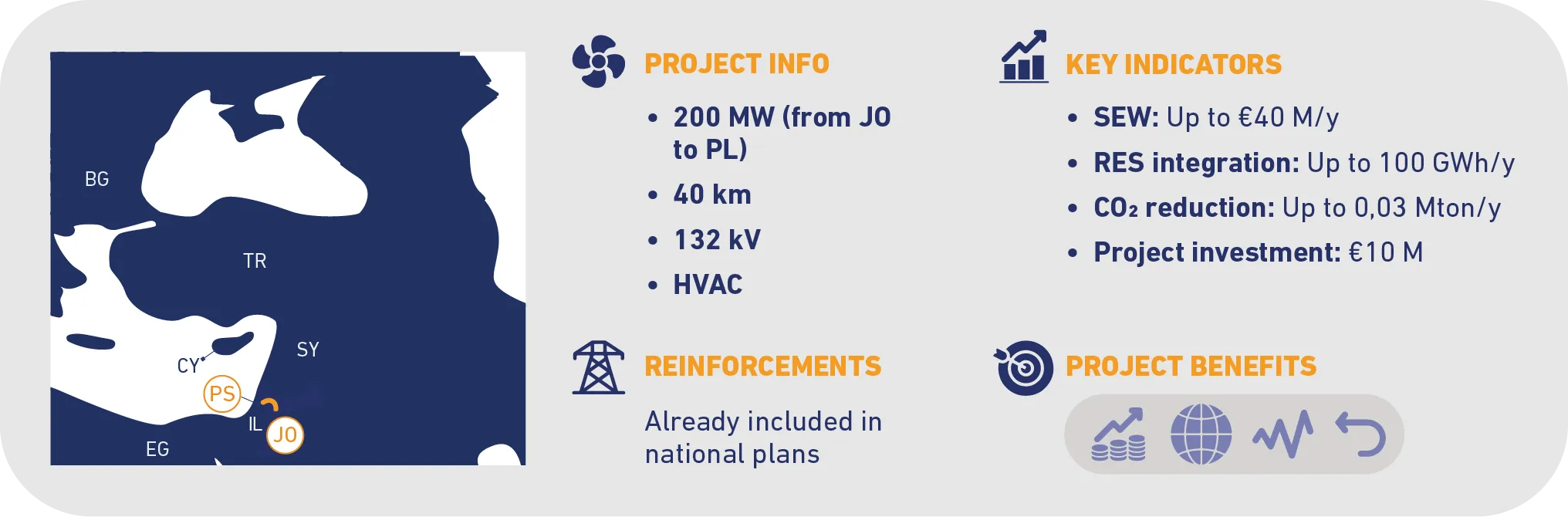
Project 114: Jordan - Palestine+200/-01.1, 1.2, 1.3, 2.1, 3.1, 3.3, 3.4, 4.1
Project 120: Egypt - Jordan+5501.1, 1.2, 1.3, 3.2, 3.3, 3.4, 4.1

Table 2: List of projects and main figures

4.2

The West Mediterranean Corridor

The West Mediterranean corridor includes the assessments of one project involving Morocco and Spain by 2030 horizon. This project builds on the existing integration between the Iberian electricity market and the Maghreb region. As a result, its expected benefits are well aligned, showing a clear positive contribution in terms of:

  1. Reducing the electricity price differential between the Iberian market and Maghreb countries by leveraging the lower prices observed in Spain
  2. Increasing renewable energy integration — particularly by avoiding curtailment in Spain and channelling the surplus to Maghreb countries, thereby reducing gas-based generations in Morocco
  3. Contributing to the achievement of specific interconnection targets, particularly those quantitatively defined for European countries  
  4. Enhancing operational flexibility through the technical features of the implemented technologies, especially VSC-HVDC systems, which offer capabilities such as black-start and voltage control.
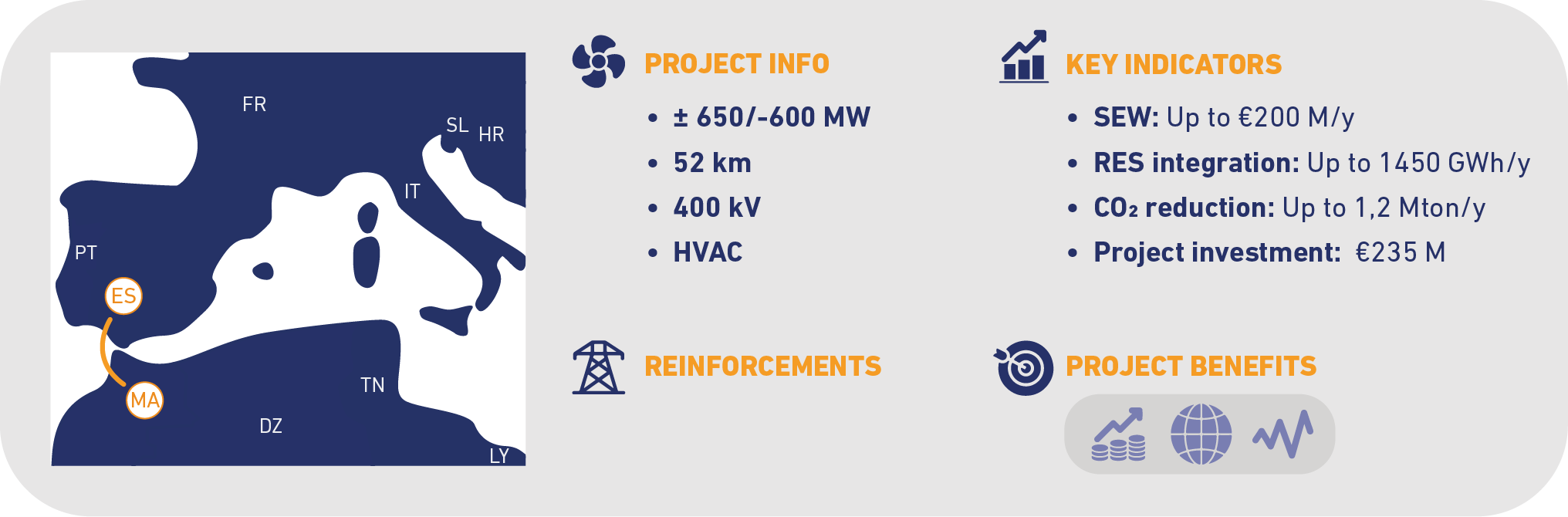
Project n°102: Spain – Morocco (ES-MA)
project-102-spain-morocco
Figure 5: Project n°102: Spain - Morocco (ES-MA)

This project involves the construction of a new interconnection between Morocco (Ben Harchane) and Spain (Puerto de la Cruz). It will add a third link, based on HVAC technology, to the two existing interconnections, increasing the NTC by 650 MW from Spain to Morocco and 600 MW in the opposite direction. The total length of the interconnection line is approximately 52 km, including a 37 km subsea cable.

Promoted by ONEE and REE, the project is included in the latest editions of both the Moroccan and Spanish National Development Plans. It is considered mature due to its relatively short length and the fact that the two power systems have been synchronised since 1997, when the first interconnection became operational.

4.3

Central Mediterranean Corridor & North Africa Backbone

This group includes two interconnection projects at strengthening the interconnections among Maghreb countries and linking them to the Italian network. Italy has a high share of renewables in its energy mix, along with thermal power overcapacity. Demand in Tunisia is expected to double over the next decade, while the Italian TSO anticipates demand saturation, and is seeking new markets to optimise renewables power flows to and from its islands, Sicily and Sardinia.

New interconnections also bring greater flexibility, enabling an increased share of renewable energy on both shores of the Mediterranean Sea. As a result, this cluster is expected to reduce the overall volume of curtailed renewable energy. Additionally, STEG anticipates that the project will reduce the need for continuous investment in new Conventional power generation units while providing access to reliable electricity at a lower cost.

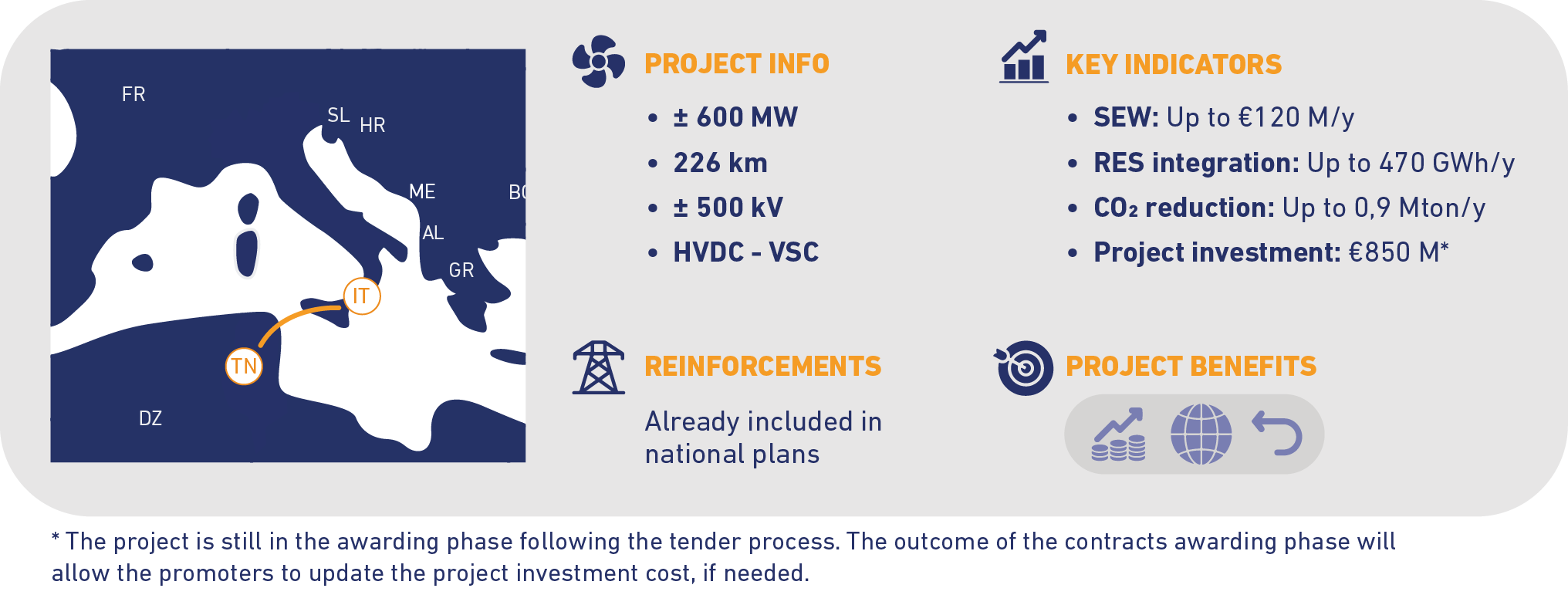
Project n°204: Italy – Tunisia (IT-TN)
project-204-Italy-Tunisia
Figure 6: Project n°204: Italy – Tunisia (IT-TN)

The Italy-Tunisia interconnection will be the first link between the two countries and the first in the central corridor connecting the North and South banks of the Mediterranean. This project has been strongly promoted and prioritised by TERNA and STEG, with the support of both the Italian and Tunisian governments. It has also been endorsed by the European Commission, which has recognised it as both a Project of Common Interest (PCI) and a Project of Mutual Interest (PMI) since 2017. Highlighting its strategic importance, the European Commission announced in December 2022 that the project had secured €307.6 million in funding from the “Connecting Europe Facility” (CEF). The interconnection is considered highly strategic for both countries, as it will optimise renewable energy flows, enhance grid operations, and help meet security and adequacy standards.

By 2024, the project had received full authorisation in both Italy and Tunisia, and construction is currently underway. Due to its advanced stage, the Italy-Tunisia interconnection has already been integrated to the reference grid for the 2030 base case of Med-TSO studies. Since 2015, it has been analysed using the TOOT methodology in all editions of the Mediterranean Master Plan.

The project will link northeastern Tunisia with Sicily via a 500 kV HVDC submarine interconnection using VSC technology, with a rated power of 600 MW. The cable will extend from Mlaabi (Tunisia) to Partanna (Sicily, Italy), where two converter stations will be constructed. The total length of interconnections is 226 km, including 200 km of submarine cable reaching a maximum depth of approximately 800 metres. Further details can be found on the official project website¹ and in the latest Italian National Development Plan.²

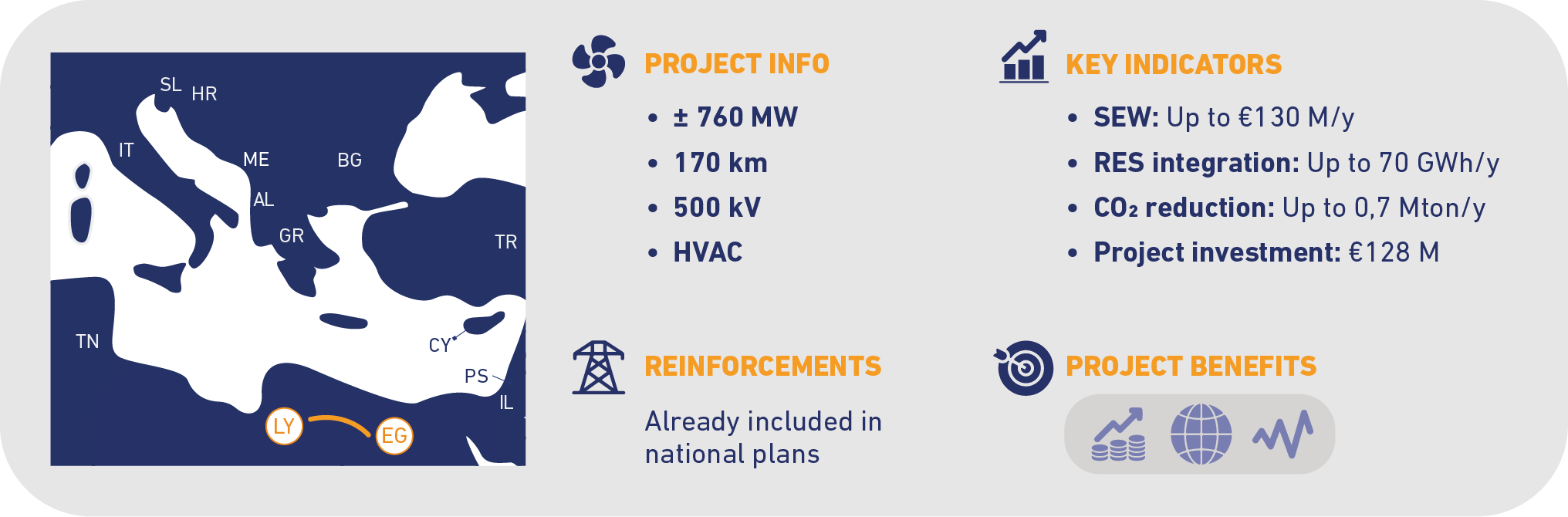
Project n°218: Egypt – Libya
project-218-Egypt-Libya
Figure 7: Project n°18: Egypt – Libya

Libya and Egypt have been electrically interconnected since May 1998 via a 170 km 220 kV, double circuit AC overhead transmission line (OHTL). The line connects the Al Saloum (Egypt) substation to the Tobruk (Libya) substation with an exchange capacity of approximately 240 MW

This current project involves the construction of a new 500 kV double-circuit OHTL along the same route between Tobruk and Saloum with a total length of about 170km. This upgrade could theoretically increase the interconnection capacity from the existing 240 MW to up to 1,000 MW.

4.4

The East Mediterranean Interconnectors

This group includes one interconnection project linking countries on both shores of the Eastern Mediterranean, thereby establishing new electricity corridors in the region. The project aims to deliver mutual benefits by leveraging the complementary energy profiles and price differences of the countries involved. Specifically, it connects the power system of Cyprus to Israel and, in turn, to the Greek system.

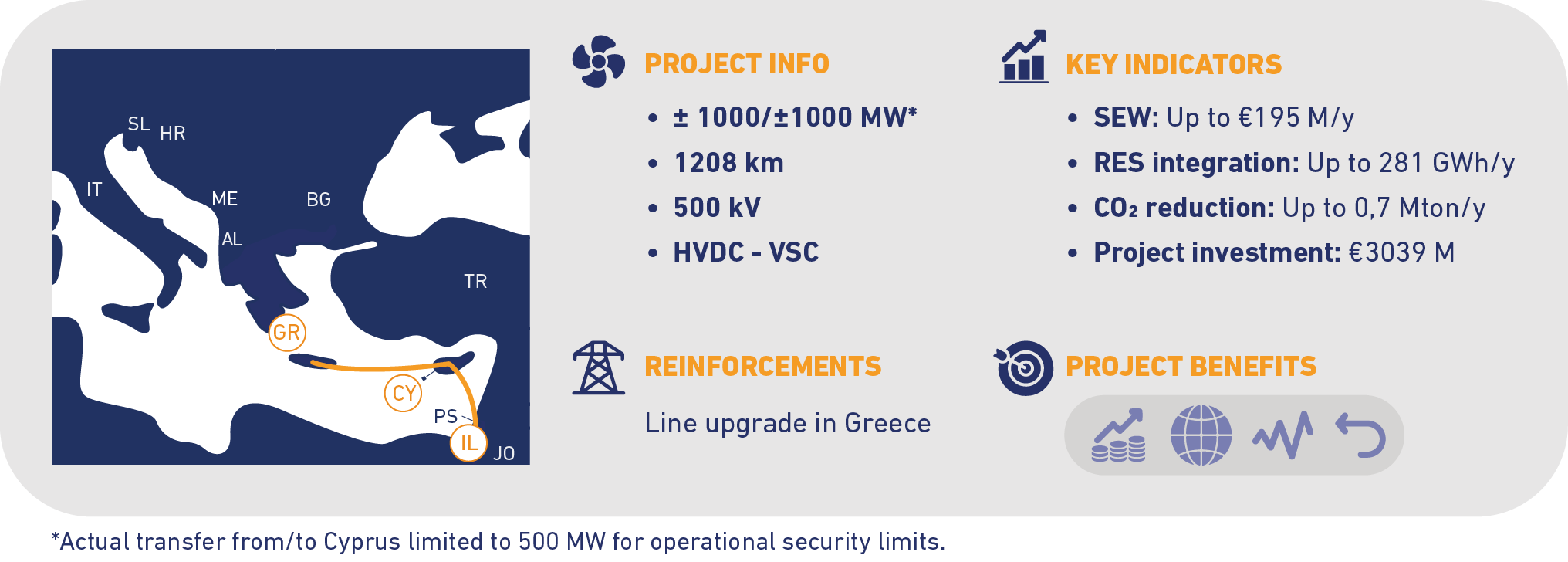
Project n°212: Greece – Cyprus – Israel
project-n212-greece-cyprus-israel
Figure 8: Project n°212: Greece – Cyprus – Israel

Greece is well interconnected with Italy, Türkiye and its Balkan neighbouring countries through seven interconnections: 1 DC link with Italy and 6 AC interconnections: one with Türkiye, one with Bulgaria, two with North Macedonia and two with Albania.

Although a member of the EU, Cyprus remains fully isolated, with no electricity or gas interconnections. Due to its autonomous power system, the penetration of renewable energy sources (RES) on the island is currently limited. Achieving higher levels of RES integration, in line with the EU’s ambitious targets, could significantly impact the island’s security of supply.

The project involves two new interconnections: one between Greece (Crete) and Cyprus, and another between Cyprus and Israel. Both links will be implemented using HVDC submarine cables with a combined length of approximately 1,200 km (nearly 314 km between Cyprus and Israel, and 894 km between Cyprus and Crete). The HVDC system based on VSC technology will have a transmission capacity of 1,000 MW and support bidirectional power flow. However, due to operational security reasons, imports to and exports from the Cyprus power system will initially be limited to around 500 MW. These limitations may be revised over time, depending on technological advancements and the integration of new reserve-capable resources into the Cyprus system.

The project has entered the construction phase and has secured EU co-financing. Specifically, the first segment (Greece–Cyprus) is a key component of the revised (2024) Cyprus NECP for achieving the country’s 2030 RES penetration targets. This segment has obtained €657 million in EU funding. Given its advanced status, this project is considered sufficiently mature to be included in the reference grid for the year 2030.

The main driver for this project is to end the energy isolation of Cyprus. Interconnecting the Cyprus power is expected to enable the integration of a high share of RES and support significant RES development on the island. This will lead to a reduction of CO₂ emissions and provide substantial economic and environmental benefits for all participating countries. Additionally, the project will establish a new electricity transfer route linking Israel, Cyprus, Crete and Greece, generating mutual benefits by leveraging the complementary energy profiles and price differences among these countries.

4.5

The Eastern Balkan Corridor

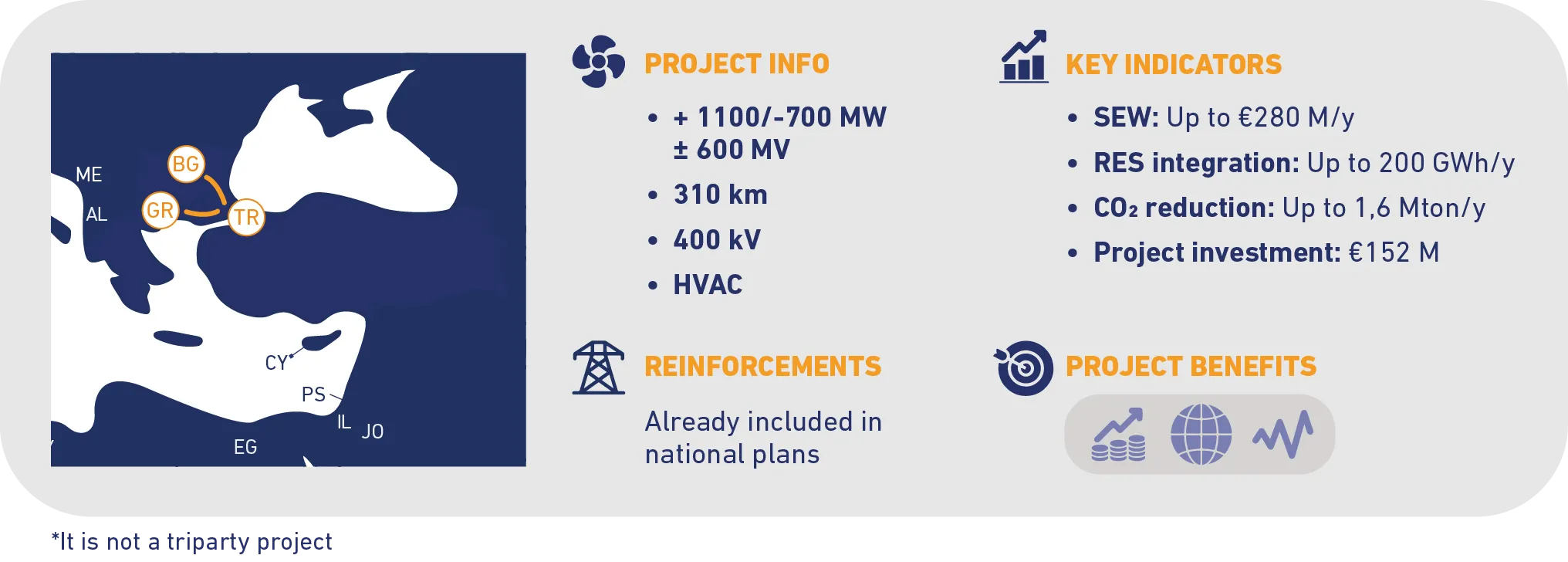
This corridor includes three interconnection projects: “Bulgaria–Türkiye–Greece”, “Italy–Greece” and “Greece–Albania”. The first project aims to increase the existing NTC between Türkiye and Continental Europe Synchronous Area (CESA), to which Türkiye is already synchronously connected. It will increase the NTC between Türkiye and Greece by approximately 600 MW, and between Türkiye and Bulgaria by about 700-1,100 MW. The second project seeks to enhance the existing NTC between Italy and Greece by an additional 1000 MW. It involves an HVDC submarine cable linking the Galatina substation (Italy) to the Arachthos substation (Greece). The third project focuses on increasing the NTC between Greece and Albania by about 200 MW.

The increased interconnection capacity between Türkiye and CESA through the Bulgaria– Türkiye–Greece project will facilitate the transfer of significant renewable energy from the Balkan region to Türkiye. This is expected to reduce thermal generation and lower CO₂ emissions in Türkiye.

The Italy–Greece project will effectively triple the interconnection capacity between the two countries, enhancing system reliability and operational security.

Project n°111: Bulgaria – Türkiye – Greece (BG-TR-GR)
project-n111-Bulgaria-Türkiye -Greece
Figure 9: Project n°111: Bulgaria-Türkiye -Greece (BG-TR-GR)

In 2010, the Turkish power system was synchronised with the Continental Europe Synchronous Area (CESA), with Greece and Bulgaria forming the transmission corridor between CESA and Türkiye. Currently, there is one interconnection between Greece and Bulgaria, one between Greece and Türkiye and two between Bulgaria and Türkiye. The existing NTC is limited to 650 MW from CESA to Türkiye and 500 MW in the opposite direction. However, the construction of a second interconnection between Greece and Bulgaria, along with the ongoing reinforcement of the 400 KV grid in South-East Bulgaria is expected to increase the NTC to 1,350 MW towards Türkiye and 1250 MW in the opposite direction.

Greece is currently well interconnected with 1 DC and 6 AC interconnections. In addition to links with Türkiye and Bulgaria, Greece is connected to the power systems of North Macedonia, Albania and Italy. The Turkish grid, apart from its interconnections with Greece and Bulgaria, is also connected to the grids of Syria, Iraq, Iran and Georgia.

The current project involves the development of two new interconnections: one between Greece and Türkiye, and another between Bulgaria and Türkiye. Both will be implemented as AC overhead lines. Promoted by IPTO, TEIAS and ESO, the project aims to increase the interconnection capacity between Türkiye and the CESA by approximately 1,000 MW.

Project n°217:  Italy – Greece 
project-n217-italy-greece
Figure 9: Project n°111: Bulgaria-Türkiye -Greece (BG-TR-GR)

Southern Italy is characterised by a highly saturated grid, driven by increasing energy flows. This is due to both the high level of renewable energy generation and the continued operation of conventional generation units, which are essential for maintaining system stability. To meet policy objectives, ensure the safe operation of the network, and improve market and service efficiency, particularly by unlocking new resources through the coupling of the Services Market, it will be essential in the coming years to expand transmission capacity in the South through new interconnections with neighbouring countries. 7

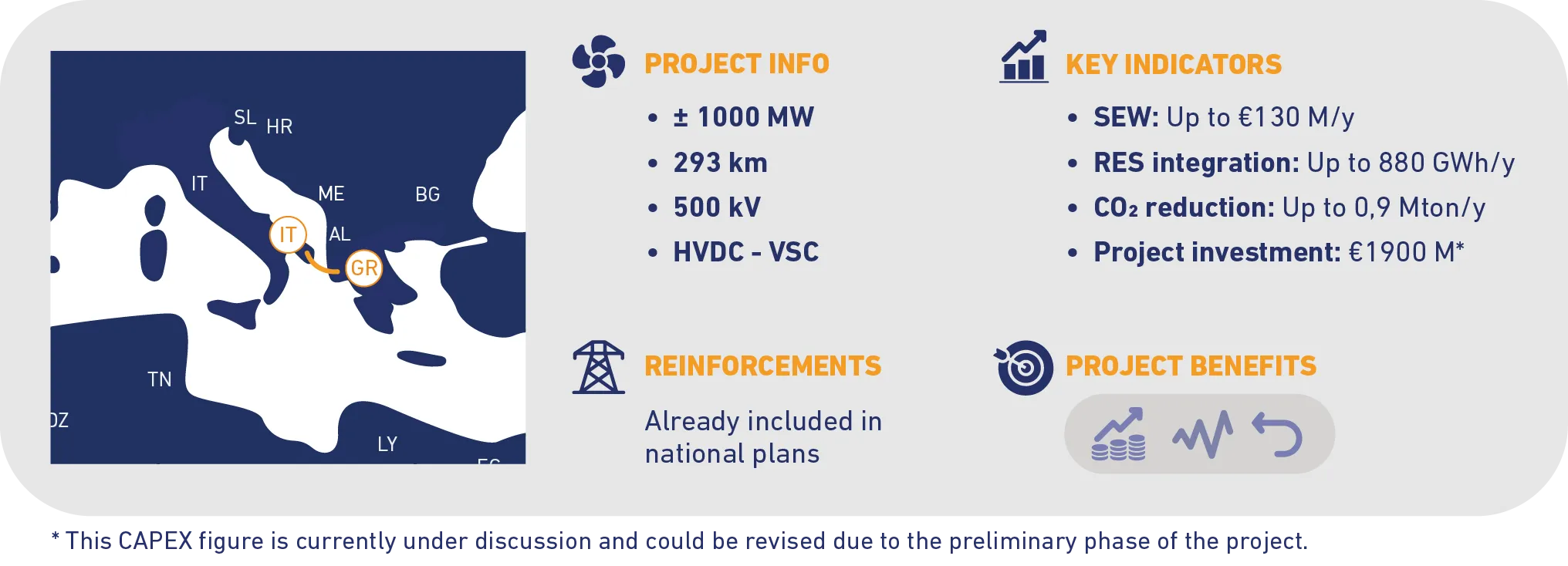
In this context, the existing HVDC connection between Italy and Greece interconnection (GR. ITA. 1), based on LCC technology with a capacity of 500 MW, has played a key role in the safe management of southern Italy since its commissioning in 2001. It enables power exchange with Eastern Europe (exports) and supports the Southern region by providing demand coverage and reserve margins (imports).

The Italy-Greece interconnection project (also known as GR.ITA.2) involves the construction of a new HVDC link between the two countries, implemented via submarine cables. The project aims to increase the interconnection capacity between Italy and Greece by an additional 1,000 MW. It consists of a new HVDC VSC interconnection in a bipolar configuration, spanning a total length of 293 km, including 240 km of submarine cable. The link will connect the Galatina substation in Italy to the new Thesprotia substation in Greece. With a rated capacity of 1,000 MW, this project will raise the total transmission capacity on the Italy-Greece border to 1,500 MW. Further information is available in the latest editions of both the Italian³ and Greek National Development Plans.

Project n°122:  Albania – Greece 
project-n122-Greece -Albania
Figure 11: Project n°122: Albania – Greece 

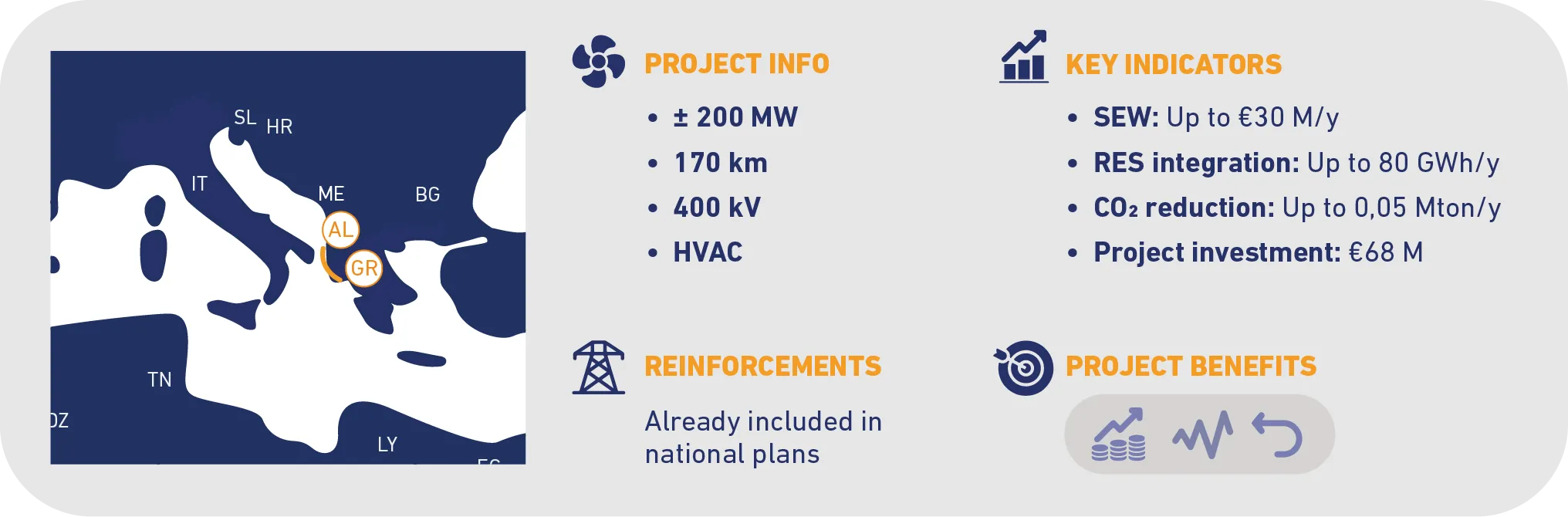
In December 2022, IPTO and OST decided to implement the new 400 kV overhead line (OHL) between Greece and Albania, with a completion horizon of 2030. The new single-circuit 400 kV OHL will connect a new Thesprotia substation in Western Greece (linked to the Arachthos substation) with the Fier substation in Albania. It will have a nominal transmission capacity of 2,000 MVA and an estimated total length of approximately 170 km, of which 45 km will be in Greek territory and 125 km in Albanian territory. The new OHL is expected to increase the transmission capacity between the two countries by at least 200 MW in both directions. The project will support higher penetration of RES in the two systems, enhance market convergence and contribute to the EU’s climate-neutrality goals. The interconnection is estimated to be commissioned by 2031.

The project has been included in the ENTSO-E Ten-Year Network Development Plan (TYNDP 2024) under the code TR 1183⁴ with the Investment ID and name: 1988 – New Single-Circuit OHL 400 kV Thesprotia (GR) – Fier (AL).

4  TR 1183 – New interconnection line 400 kV Greece – Albania. https://tyndp2024.entsoe.eu/projects-map/Transmission/1183

4.6

Middle East-Mediterranean Integration

This cluster includes two interconnection projects involving new OHLs aimed at strengthening connections between Eastern Mediterranean countries, and further increasing the existing NTC among them.

Project n°120: Egypt – Jordan (EG-JO)
project-n120-egypt-jordan
Figure 12: Project n°120: Egypt – Jordan (EG-JO)

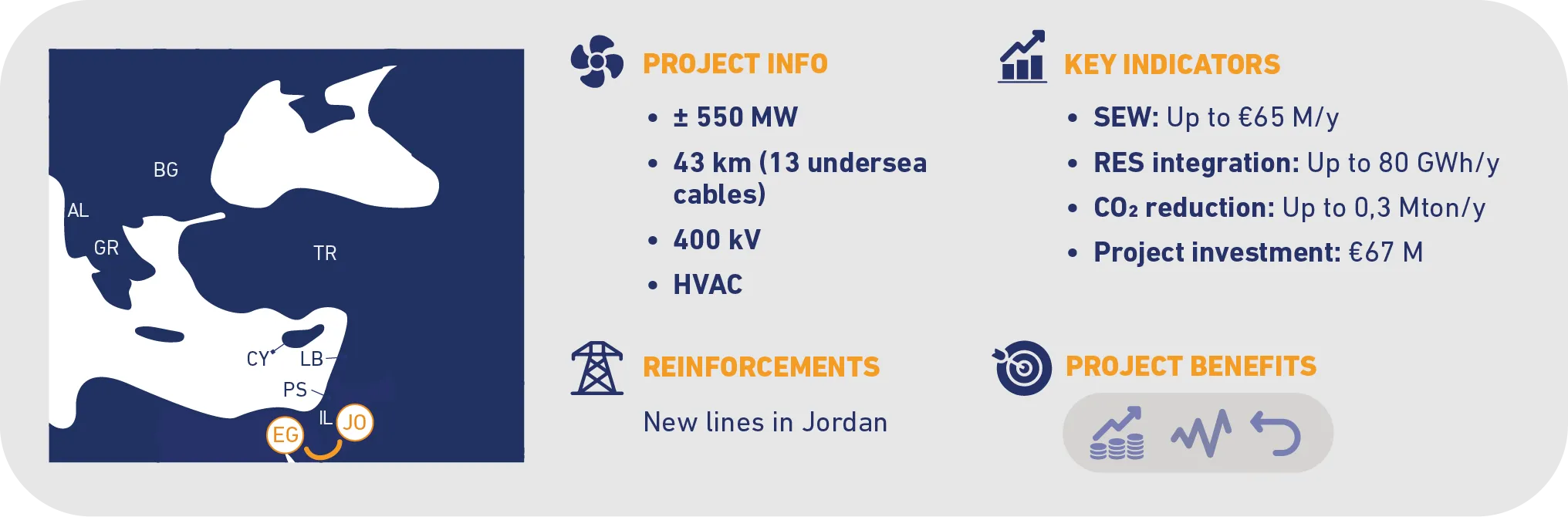
Jordan and Egypt have been electrically interconnected since 1998 via a 13 km 400 kV, AC submarine cable (3 cores + 1 spare) laid at a depth of 850 metres across Taba in the Gulf of Aqaba. This interconnection has an exchange capability of 550 MW. Project 120 involves the construction of a second 13 km 400 kV AC submarine cable between the two countries. This new link is expected to double the current transfer capacity to 1,100 MW, helping to mitigate potential overloads along the existing interconnection path.

The Egyptian grid is currently interconnected with the grids of Libya, Jordan and Sudan. A new HVDC interconnection between Egypt and Saudi Arabia is under development, with a new NTC of 3,000 MW expected to be in place by 2030. This interconnection is part of a border 400 kV regional grid plan, aimed at linking the GCC Interconnection Authority Grid (connecting the six GCC countries at 400 kV) with the power systems of Jordan and Egypt. The goal is to enhance system reliability, improve quality of supply and support the creation of an integrated electricity market across the Arab region. In addition to Egypt, Jordan is also interconnected with Palestine, Syria and Iraq.

Project n°121: Jordan – Syria – Lebanon (JO-SY-LB)
Figure 13: Project n°121: Jordan – Syria – Lebanon (JO-SY-LB)

The interconnection between Jordan, Syria and Lebanon was implemented between January 2001 and December 2005, covering a total distance of approximately 400 km. In Jordan, the interconnection consists of a single circuit 400 kV line from the Amman North 400/132 kV substation to the Syrian border, continuing into Syria to the Deir Ali 400/230 kV substation, with a length of approximately 144 km. From Deir Ali to Dimas (both in Syria), the link continues as a single circuit 400 kV line about 42 km long. In Lebanon, the interconnection includes a double circuit 400 kV line from the Ksara 400/220 kV substation to the Syrian border, then a single-circuit line connecting to the Dimas substation in Syria. The total length of this segment is approximately 42 km.

The designated transmission capacity of this interconnection is 800 MW. However, it is currently out of operation.

Project n°114:  Jordan – Palestine (JO-PS) 
project-n114-jordan-palestine
Figure 14: Project n°114: Jordan – Palestine (JO-PS)

The project involves the construction of a new AC 132 kV overhead line interconnection between Jordan and Palestine. It is expected to increase the transfer capacity between the two systems by approximately 100 MW, with the aim of supplying electricity to Palestine on an isolated-grid basis.

Interconnections 2030

x x x The interconnections shown in this map are only a graphic representation and they do not show the real position of the interconnection lines

For having a complete understanding of the Project, we invite you to download the complete Project Sheet.